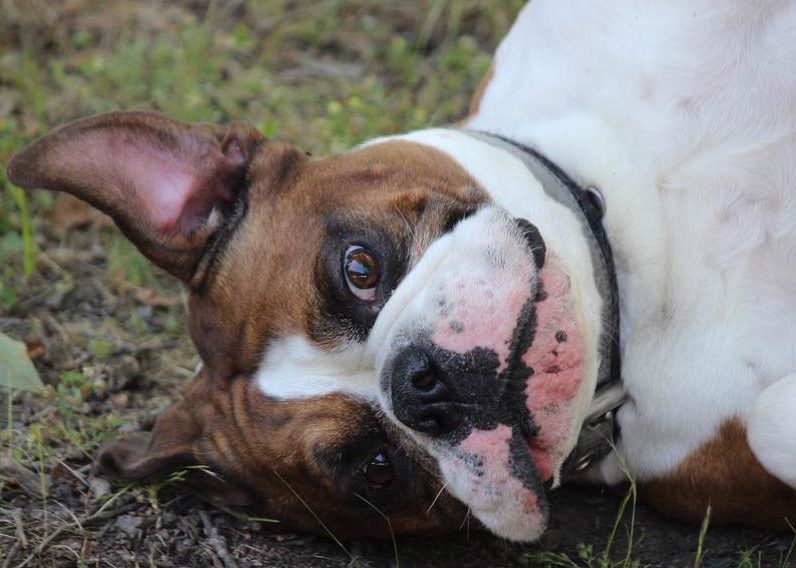
This article was in the below ‘Dogzine’ magazine regarding the Leavitt Bulldog. I’ve translated it to English here (though you can do so in Google Chrome by right clicking on the page and choosing ‘translate to English’)
https://dogzine.nl/index.php/en/node/853
Is the English bulldog to be saved?

On BBC-1, Catherine Tate paid attention to the problems surrounding the English bulldog on Wednesday evening. She made a documentary about the British symbol, the English bulldog, because the breed is very deep in the danger zone. Does this breed have a future? Or is the symbol of the British doomed to perish?
Tate is a dog lover, even though she does not have a bulldog. Her approach was to investigate where things went wrong. Because that is the case, there is no doubt for her. The average age is eight years (that is with a non-pedigree, the figures from the English Kennel Club say six years).
With the birth, 86% is cesarean and around 50% of the animals suffer from respiratory problems.
And then there are eye problems, knee problems and skin problems.
Everyone seems to agree that there is a problem, but what to do about it? That turned out to be the big question that did not receive an answer.
The English Kennel Club (which, incidentally, is not FCI) is very aware of the problem, but has not made testing mandatory. The reason for this is according to Bill Lambert, who has health and breeding in his portefueille, that the KC tries to keep people within the organization. “And we prefer to do that by encouragement and persuasion rather than by coercion.”
According to Lambert, the irresponsible breeders are the culprits. It was a matter of supply and demand, he determined, which makes it irresponsible to breed. But the KC is working on research into the genes that cause brachycephalia, the official name for short-sightedness.
Dr. Rowena Packer of the Royal Veterinary College saw it very differently: It is a beautiful breed, an icon, but in this form it is not “fit for life”, she said. “We will have to fundamentally change the appearance if we want to preserve this variety. And the gene pool is so small that selection via DNA would only make things worse. ”
That made it all more complicated, but can we save the breed? Jeff Schoenebeck of the Roslin Institute (you know, where Dolly the sheep came from) talks about that mutation: “We have found a mutation that makes the muzzle shorter and shorter. And the English bulldog does not have just one copy of it. They have two, all of them. So we can not breed away, there is nothing else than this. ”
Schoenebeck has a clear answer to the question of whether the breed can be saved:” No. Fresh genes are needed for this. And that means that a different race should be crossed, so that we get rid of those wrong genes. ”
That is clear language. It is not the irresponsible breeders or the rigid breed standard. It is up to the breed.

The “outcross” that Schoenbecke talks about is already happening, albeit outside the official studbooks. Even since the seventies even. There is the Leavitt bulldog, a dog that originated from crossings of an English bulldog with a bullterrier, a bullmastiff and an American bulldog. The basis for this was David Leavitt, who already noticed during that period that the English bulldog of that time no longer resembled the old bulldog. It is a breed that has been registered from the beginning, has strict health requirements and is healthy and strong. It does not have any of the health problems that plague the current English bulldog. To summarize, we can say that there is hope, but perhaps not as the fans of English bulldogs would like to see. Dogzine hopes soon with Dr. Schoenbecke to speak on this subject. A portrait of the Leavitt bulldog will be in the Dogzine from May-June.
 The Determined Bullblog